
Picky Eater Meal Planning: Your Kid Eats 6 Things, and That's a Meal Plan
Your kid eats 6 things? That's not a problem — that's picky eater meal planning. Build a weeknight rotation that works with fussy eaters, not against them.
Picky Eater Meal Planning: Your Kid Eats 6 Things, and That’s a Meal Plan
You know the flat “no” before the plate has even fully landed on the table, and you know, with the certainty of someone who’s lived this a hundred times, that you’re about to make plain pasta.
Picky eater meal planning doesn’t start with expanding the menu. It starts with working with what your kid actually eats.
Six meals is a rotation, not a limitation
Most advice about picky eaters focuses on getting them to eat more things. Hide the vegetables. Make food fun. Keep offering. And maybe that works, eventually, over months or years. But tonight, you still need to feed your family.
So try starting somewhere different. If your child reliably eats six things, you don’t have a limitation. You have a rotation. Six meals across five weeknights is more than enough. One spare, in fact, for the evening when even the reliable option doesn’t land. That’s not a restricted diet. That’s a weekly plan with a backup.
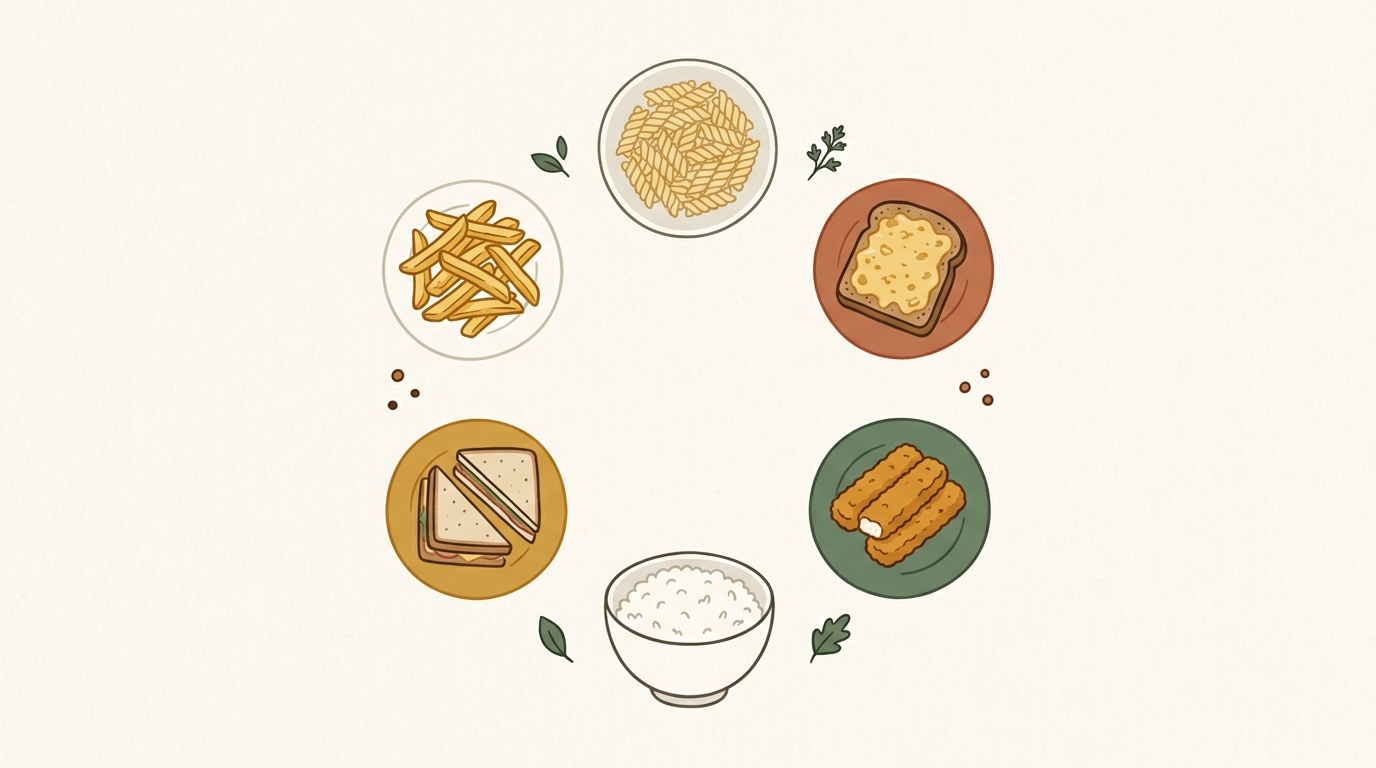
Write those six meals down. Not the meals you wish they’d eat. Not the meals from the parenting book or the health visitor’s leaflet. The meals your child will actually sit down and eat without a fight. Plain pasta. Cheese on toast. Fish fingers and chips. Rice with nothing on it. Whatever they are, they count. They’re the foundation, and there’s nothing wrong with a foundation that’s mostly beige. About half of all young children go through a phase of eating like this. You’re not the exception. You’re squarely in the middle.
This isn’t giving up. It’s stopping the war so you can plan the peace.
The guilt can feel heavy, that quiet sense that other families have somehow cracked the code on roasted cauliflower. But that comparison is between your real kitchen and an imagined one where nobody’s ever thrown broccoli on the floor, where every meal is eaten with enthusiasm, where the word “no” doesn’t feature at dinner. That kitchen doesn’t exist. Not in as many homes as you’d think, anyway. Yours does, and yours can work.
Building your picky eater meal plan around what works
Once you’ve got your list, map those meals across the week. The mapping doesn’t need to be clever. It needs to be functional.
Put the easiest meal on your hardest day. If Wednesday is always chaotic (late pickup, activities, one parent working late), that’s fish finger night. Zero effort, zero drama, everyone eats. Save the meal that takes a bit more time for a calmer evening, when you’ve actually got twenty minutes and a clear counter.
Alternate by effort, not nutrition. Monday can be the meal that takes slightly longer. Tuesday, something simpler. Wednesday, your easiest option. Thursday, moderate. Friday, the kids pick. This rhythm means you’re never stacking two hard cooking nights back to back, and that matters more than you’d think on a Thursday when you’ve already cooked properly twice this week.
Keep the adult meal close to the kid meal. If they’re having plain pasta, you’re having pasta with sauce on the side. Same base, different finish. You’re not cooking two separate dinners. You’re cooking one dinner with a fork in the road. One shopping list, one cooking session, nobody standing at the hob feeling like a short-order cook. If the adults want something more interesting, add it on the side: a salad, some spice, a sauce. The base stays the same. [INTERNAL LINK: plan-weeknight-dinners-10-minutes]
Then write the plan somewhere visible. The fridge, a whiteboard, a shared note on your phone. Kids who know what’s coming have fewer surprises at the table. And fewer surprises means fewer refusals. You might find the adults benefit from the visibility too. There’s a quiet relief in knowing that Monday is pasta, Tuesday is fish fingers, Wednesday is rice with something simple. You’re not deciding at half five with a hungry child pulling at your leg. It’s already decided. [INTERNAL LINK: food-decision-fatigue-dinner]
That daily “what will they actually eat tonight?” question is its own kind of fatigue. It sits in the background of your afternoon, taking up space you could use for literally anything else. Removing it doesn’t feel like much until you’ve lived a week without it. Then it feels like everything.
And one more thing: don’t cook two separate dinners. This is the trap that turns picky eater meal planning from manageable to exhausting. One dinner, served two ways, is sustainable for months. Two completely different meals every night leads to burnout and to more food going in the bin than on the plate. If your child won’t eat the sauce, serve the sauce on the side. If they won’t eat the vegetables, put the vegetables on your plate, not theirs. The dinner is still one dinner. [INTERNAL LINK: food-waste-family-cost]
One new, four familiar
The rotation isn’t where you stay forever. It’s where you start. Once the base is stable, once mealtimes feel less like a negotiation and more like a meal, you can begin adding. Not because the rotation is lacking, but because the calm you’ve built gives you room to try things.
One new meal per week, alongside four familiar ones. That’s it. Not three new meals. Not a reinvented menu. One. Put it on a night when you’ve got a bit of energy and nobody’s overtired. If it gets rejected, no drama. The rotation still holds. Nobody goes hungry. You just try again in a few weeks.
Children typically need somewhere between 10 and 15 encounters with a new food before they’ll try it, let alone accept it. That’s not 10 nights in a row. It’s 10 separate occasions, spread over weeks or months, where the food appears on the table without pressure. Some of those times they won’t touch it. Some times they’ll poke it with a fork and put the fork down. One time, weeks from now, they might taste it. Eventually, it shifts from “new” to “known.” It’s slow. It’s supposed to be slow.
The key is that the new food isn’t the dinner. It’s alongside the dinner. The rotation still holds. If the new thing gets pushed to the side of the plate, there’s still a full meal of familiar food right there. Nobody goes hungry, nobody cries, and you haven’t wasted an evening cooking something that ends up in the bin. The new thing is just visiting. It’ll come back.
The picky eating phase, what researchers call food neophobia, tends to peak between ages two and seven. It’s a normal part of how children develop. Not a reflection of your cooking, not a sign that something’s wrong. The long view is genuinely reassuring. Those same children, a decade or so later, typically eat a wide and varied diet. One parent put it in perspective that’s hard to forget: “She’s now 22 and eats anything.”
The bridge between “eats six things” and “eats anything” is time, patience, and a table where food isn’t a battle. Not tricks. Not hidden vegetables. Not the elaborate ruse where cauliflower becomes “white trees.” Just steady, quiet exposure alongside the meals that already work.
In the meantime, your rotation holds the line. Picky eater meal planning doesn’t require heroics. It requires a short list, a predictable week, and the willingness to accept that plain pasta on a Tuesday is a perfectly valid dinner. Because it is.
A calm table is the win
Success with picky eater meal planning doesn’t look like a colourful, balanced plate your child eats with enthusiasm. It looks like sitting down at six o’clock without dread. It looks like everyone at the table eating something, even if it’s not the same thing, even if one of those somethings is plain rice for the third time this week. It looks like the absence of a fight after a long day, when everyone’s tired and nobody needs one more thing to get through.
It looks like Tuesday evening, kitchen light on, pasta water boiling, and nobody negotiating. You know what’s for dinner. They know what’s for dinner. The only question is whether there’s enough cheese.
A family that eats without conflict is worth more than a family that eats broccoli. The calm matters. The predictability matters. The way your shoulders come down when dinner isn’t a question anymore, that matters more than any single vegetable on any single plate.
Your kid eats six things. That’s not a problem. That’s Monday through Friday, with a spare.
[PHASE 1 CTA PLACEHOLDER]